Lela Stratton


M-Audio Hammer 88


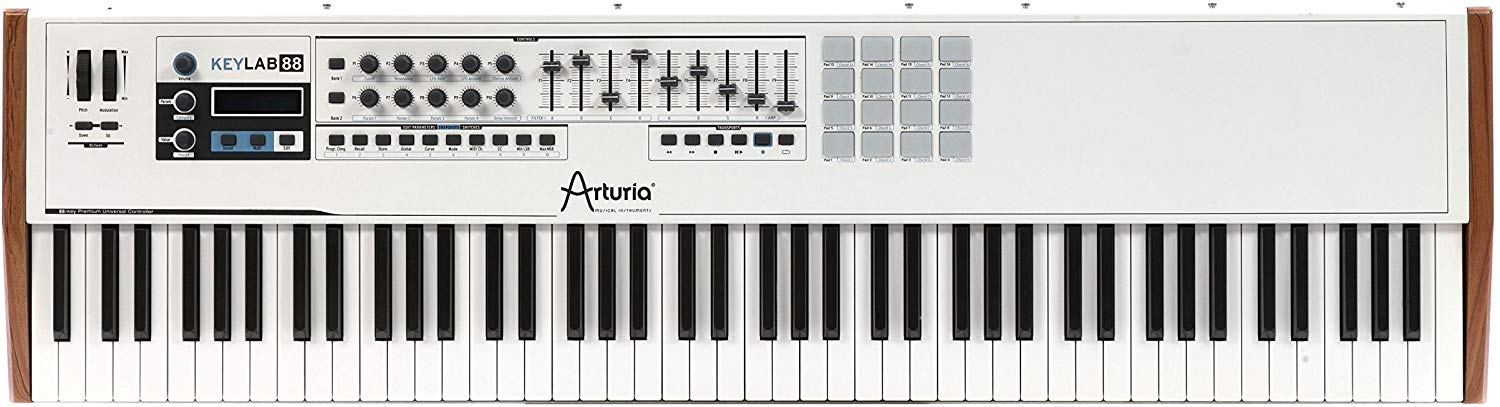
Arturia Keylab 88


Akai MPK88
Show Content
Are you a musician or person with an interest in music and instruments? Then you must have always loved the sweet sound coming out of a weighted MIDI keyboard. The weighted MIDI keyboard controller is an integral part of today's band music.
MIDI can be both hardware and software whose primary function is to produce and transfer musical data to MIDI-enabled devices. There are many types of MIDI controllers. For example, keyboards, wind controllers, drum and percussion controllers, stringed instrument controllers, specialized performance controllers. Among all of these, the keyboard controller is the most common and famous one.
People, whether for professional purposes or hobby, all love the weighted MIDI keyboard controller as it enhances the music quality. A MIDI keyboard, however, is not designed to produce sound by itself. The interfaces of the keyboard connected to a MIDI device. When the performer presses, touches, strikes, or blows the keys, the data transmitted to the device, and the corresponding sound produced. While the most common use of MIDI devices is in the keyboard music sector, these devices also used in stage lighting, digital audio mixers, sophisticated guitar effects units.
Top 5 Best Weighted MIDI Keyboard Controllers List
The MIDI keyboard controller's performance mainly depends on the performer. However, the weight of the keys is also an essential factor. There is both weighted and semi-weighted keyboard available in the market. The weighted one widely used, and most musicians suggest it. Below, we have listed the top 5 of our products. We have added some reviews so that it helps you to decide on choosing one to buy. Here we go-
1
M-Audio Hammer 88
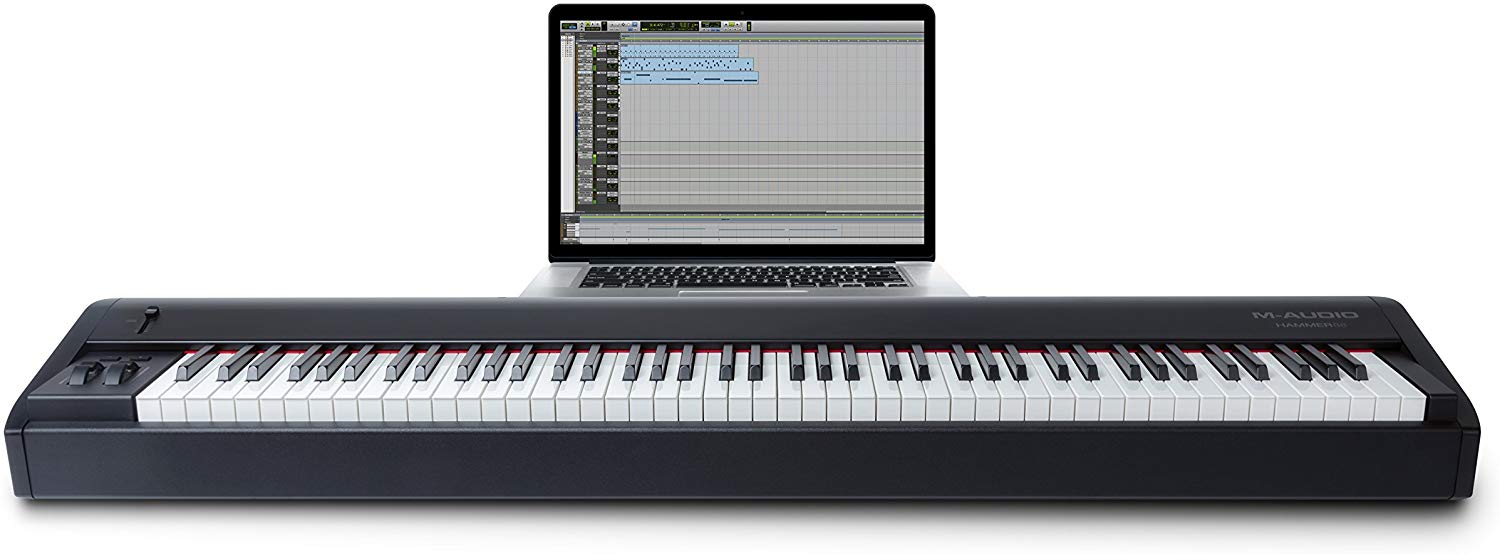
The M-Audio Hammer 88 is a high class, fully weighted MIDI keyboard. The sounds it produces are realistic and noise-free. It delivers a natural piano feel. The keys are velocity-sensitive. Its USB powered connection provides a smooth data transfer experience. Modulation, pitch bend, volume, and octave control appropriately located for outstanding output. Extended control options for expressive, sustainable, and soft-pedal inputs included. Three dedicated pedal inputs added to express more realism. There are options for adding external MIDI hardware by a dedicated five-pin MIDI DIN port. To play 4-note chords with only one keypress, multiple keyboard zones are available. No drivers required for connectivity. The pedal inputs are 3×1/4", MIDI out, USB 1×type B.
The height, width, and depth of the keyboard are 5.0,", 55.9" and 11.9" respectively. It weighs 38.5 lbs. It requires a power input from 9V DC, 800mA power adapter. The required software is Ableton live light or hammer 88 software editor.
One final and vital side of M-Audio Hammer 88 is that a software bundle gifted with the keyboard which includes Ableton live light music performance and creation software, AIR mini grand acoustic piano, AIR velvet vintage electronic piano, AIR dB-33 tonewheel organ simulator, SONiVOX eighty-eight ensemble piano instrument, 3-month trial with solve – interactive piano lessons from beginner to advanced
Pros
Cons
2
Arturia Keylab 88
The white Arturia key lab 88 is stylish, along with an amazingly lightweight keyboard. Its brilliant integration with laptops or tablets is an outstanding feature for using it at home, abroad, or anywhere. Its MIDI controller and software package includes many features. It requires Ableton live light or Piano V for working but can be adapted to other applications using the MIDI control center program, which can download. It offers better control than any other standard MIDI and is designed in overlays so that quick changes between applications can be attained.
The controller has three modes, and there are three buttons to interchange between them. All the methods have their specific purposes, so it is much beneficial to be able to change them quickly. Also, the keyboard has a splitting option for creating new sounds. A USB cable, a removable iPad sheet music stand, an adapter shipped along with the Arturia Keylab 88.
The software bundle includes analog lab software with 6500 synth sounds, Ableton live light, Piano V, Wulri-V, and a Vox continental-V.
The hardware specifications are 88 note premium Fatar hammer action keyboard, 16 RGB backlit performance pads, control bank, control analog synthesizers and modular equipment, five control pedal inputs with expression, sustainability, and auxiliary pedal units, seamless integration with all Arturia software instruments, presets for multiple DAWs.
The box dimension (L×W×H) is 57.5×19.5×7.5, and weight is 48.1 lbs.
Pros
Cons
3
Akai MPK88
The Akai MPK88 keyboard controller is a beast. It has an excellent outlook with MPD, MPC MiniAK items. The black body made of metal surrounded by plastics. The dials are smooth, and all other buttons have a reassuring click.
The weighted hammer action keyboard is impressive. It is neither too light nor too heavy, has no sponginess, and slow key return that may disturb other hammer actions. It is suitable for all kinds of playing. USB connections power the MPK from a computer. Other links include a wall wart power adapter socket, MIDI I/O, footswitch jack, and an expansion pedal jack.
There are many controls following a quick scoot around the panel. First up, there are the required pitch boards, backlit in gold. To the right are the keyboard splitting controls and the 16x4 MPC pad banks picked. Below is controlled for switching on and off the MIDI-sync arpeggiator, a lock switch, and the Note Repeat feature that omitted from the MPC set to play rolls and input notes (hold the Note Repeat button and press a pad).
All in all, this is a well-built, user-friendly, and flexible controller board with a full keyboard. A good number of controls are available, and all of them are generally easy to read, plus the MPK comes with a few presets to get you going with most DAW device styles.
Pros
Cons
4
Studiologic SL73

The SL73 Studio is a very elegant, sturdy-built keyboard controller that looks very robust in its dark metal shell. It is also quite compact for a hammer-acting, 73-note device, coming in at 11.5kg/25lbs, although that weight will raise considerably as soon as you test it out.
The keyboard-based on Fatar's triple-sensor TP/100LR (with aftertouch) which can be used on boards made by Nord, Dexibell, Arturia, and Kurzweil and is built to provide piano-like expressivity with reasonable portability for those who want to move their controllers conveniently to gigs, but do not lose an excellent piano action in the process.
Sure, for those who like their piano-like and intense movements, the SL73 succeeds, but on the flip side, ultimately, we considered it too hard, taking too much initial energy to get the sound out of it and too slow to bounce back to our lighter style of playing.
Control-wise there are three stick controllers, each with an assignable X / Y axis set through a color screen and a cursor-stick mechanism. Stick one is sprung vertically and horizontally (ideal for pitch-bend), Stick 2 is free vertically / sprung horizontally and Stick three is unwrapped in all directions so that you can keep the settings at any length you put the stick on.
Pros
Cons
5
Native instruments complete Kontrol S88 MK2

NICC Series of Keyboard Controllers has been around for almost five years now, has proven to be very popular — especially with studio musicians working with NI's Complete Series of Virtual Instruments. The NKS protocol is at the center of the Comprehensive Control System, where keyboards communicate bi-directionally with instruments via the NI.
Installing the S88 MkII into your system is simple enough to require an external power supply and a USB 2.0 cable. However, before powering the S88 MkII for the first time, stand-alone KK software should be run first; this scans your system to find all your NKS-compatible tools and VST effects so that they are accessible to KK and visible in its library.
Specific noun-NKS devices can be enabled via the KK File menu, in which case S88 immediately returns to MIDI mode and functions as a regular MIDI controller. Even though NI's Noire piano loads beautifully into Kontakt, Komplete Kontrol would have none of that.
Pros
Cons
Things to Consider Before Purchasing the Best Weighted MIDI Keyboard Controller
You're on the market for a new MIDI controller for your workshop setup, and with so many options open, you need to question yourself, what do I want and need in a MIDI controller? Let's have a look at some of the factors that you should look into before purchasing one.
Number of Keys
You will always have to consider the number of keys available on a keyboard while buying one. The choices are 25-key, 49-key, 61-key, and 88-key, respectively. Do you need a full-size piano joystick, or do you have a tiny, more compact 25-key? Smaller MIDI keyboards require you to be more versatile than a small keyboard controller on your wifi backpack.
Controls
Most of the MIDI keyboards come with simple Pitch and Modulation buttons. And, there are a few keys to push the octaves on the keyboard. But you might want to get a system with additional rotary pots and faders. There are also some MIDI controllers removed from the keyboard along with these pots and faders. These features simplify the parameters in the best possible way. You have more ' hands-on ' power on this route. Check this and see what program is compliant with.
Drumpads
Another thing you need to think about is what you're going to use the device for. The MIDI keyboard is perfect for performing the piano sections. They also help to sketch improving the progressions and melodies of your song. But sometimes a better bet is to overcome the programming of a controller with Drum Pads. These designed in such a way that they increase efficiency when the beats hit out. Several manufacturers are even developing other devices using these drum pedals, such as the Machine and Push systems. It indicates that they can be multi-dimensioned. Or you may need either a MIDI keyboard or a MIDI controller.
DAW Dedicated Controllers
Many developers are making controls that fit even more accessible with their software. For example, Ableton's Push and Native Instruments ' Switch and Full Keyboards. Let's assume that you're using Ableton; for example, because of this tight integration, you would want to use Push in your music operations because it could boost your workflow.
Application Controllers
With the rise of the mobile/tablet market and applications, there are some great apps that you can use on your smartphones that you may not have heard before. It is possible to have a MIDI controller that has no external functions. But you've got an iPhone. You realize that you can use software like TouchOSC and Lemur to extend the functionality of your MIDI Controller? For applications like this, you can build your prototype with the appropriate knobs and faders and position this device right next to your MIDI controller to make the two looks like one unit.
Conclusion
I hope this helps you choose to purchase your first or next unit. It is an essential duty to make sure to recognize the need in a workshop and find out the best match for it. You may not need a large 88-key configuration, and you can simply write a 25-key MIDI keyboard. Or you might choose to configure your MIDI with a drum-pad type controller. And, if necessary, please check the products in your local store before purchasing them. Hands in access are the most significant dealer!
Now, among the five products that we have listed for you, my personal favorite is M-Audio Hammer 88. Of course, it was difficult to choose any one between these five. But there are a few reasons which let me decided.
First of all, it gives you the most realistic feel. Secondly, it has 88 keys, pitch bend, and modulation wheels. Although it is not an all-rounder, if you want a realistic piano feel, this might be your best choice too.
So, don't be late to grab this excellent product before it gets stock out.